Artificial intelligence is no longer a technology limited to research laboratories or science-fiction movies. AI tools are already being used by businesses, freelancers, developers, marketers, teachers, designers, and millions of everyday users. As AI becomes more capable, one of the biggest questions people are asking is: Which jobs will AI transform in the next five years?
The answer is more complicated than simply saying that AI will “take jobs.” In many industries, AI is more likely to automate repetitive tasks, assist employees, and change how work is performed rather than completely eliminate entire professions.
By 2031, workers may spend less time performing repetitive tasks and more time handling strategy, creativity, communication, decision-making, and complex problem-solving. Understanding these changes today can help professionals prepare for the future.
Here are seven jobs that are likely to experience significant transformation as AI continues to develop.
1. Customer Support Representatives
Customer support is one of the areas where AI is already making a major impact. Businesses are increasingly using AI-powered chatbots and virtual assistants to answer common customer questions, provide product information, track orders, and troubleshoot basic problems.
Traditional customer support often requires employees to answer the same questions repeatedly. AI can handle many of these routine conversations instantly and operate 24 hours a day.
For example, an AI assistant can answer questions such as:
- Where is my order?
- What are your business hours?
- How can I reset my password?
- What is your return policy?
- Which payment methods do you accept?
This does not necessarily mean that human customer service representatives will disappear. Instead, their responsibilities may change.
Human agents will increasingly focus on complicated complaints, emotional customers, technical problems, and situations that require judgment. Employees who know how to work alongside AI systems may become more valuable than those who only perform repetitive support tasks.
2. Data Entry Specialists
Data entry is another profession that could experience significant automation.
For decades, businesses have employed people to manually enter information into spreadsheets, databases, accounting systems, customer relationship management platforms, and other software. Although this work is important, much of it involves repetitive processes.
Modern AI systems can extract information from documents, invoices, forms, emails, and images. Optical character recognition combined with AI can understand text, while machine learning systems can classify and organize information automatically.
Instead of manually entering hundreds of records, an employee may simply review AI-generated data and correct mistakes.
This means the future role may shift from data entry operator to data verification and management specialist.
Workers can prepare themselves by learning spreadsheet automation, database management, AI tools, and basic data analysis. These skills can help them move from repetitive tasks toward higher-value responsibilities.
3. Graphic Designers
Graphic design is also being transformed by generative AI.
AI image generators can create illustrations, advertisements, social media graphics, product concepts, backgrounds, and other visual content from simple text descriptions. Businesses that previously needed hours to create basic graphics can now generate multiple concepts within minutes.
However, this does not mean professional designers are becoming irrelevant.
Design involves much more than producing an image. Professional designers understand branding, typography, composition, visual hierarchy, audience psychology, and communication. Businesses still need people who can understand a brand and make creative decisions.
The role of graphic designers may therefore evolve.
Instead of spending most of their time creating every element manually, designers may use AI to generate initial concepts and variations. They can then select, edit, refine, and combine those ideas into professional designs.
Designers who learn tools such as AI image generators, AI-assisted editing software, and automated design platforms could become significantly more productive.
The advantage may go to designers who combine human creativity with AI efficiency.
4. Content Writers
Content creation is another field experiencing rapid change.
AI writing tools can generate articles, product descriptions, social media posts, emails, summaries, scripts, and marketing copy in seconds. This has made content production faster and more accessible.
Businesses that need large amounts of basic content may increasingly use AI for first drafts and routine writing.
However, high-quality writing requires more than putting words together. Successful content needs research, originality, storytelling, expertise, fact-checking, and an understanding of the target audience.
Because of this, AI may transform the role of writers rather than completely remove it.
A content writer may increasingly work as an AI-assisted editor, researcher, strategist, and creative director. Instead of spending hours writing a basic first draft, the writer can use AI to create an initial version and then spend more time improving accuracy, adding original insights, optimizing it for search engines, and making the content engaging.
Writers who learn how to use AI effectively while maintaining their own expertise may have an advantage over those who refuse to adapt.
5. Junior Programmers and Software Developers
Software development is one of the most interesting areas affected by AI.
AI coding assistants can already generate code, explain programming concepts, identify bugs, write tests, and help developers understand unfamiliar codebases. As these systems become more capable, developers may be able to complete certain programming tasks much faster.
This could particularly affect repetitive entry-level development work.
For example, AI can assist with creating basic CRUD operations, simple API endpoints, database queries, documentation, and standard user-interface components.
But software engineering involves much more than writing code.
Developers need to understand architecture, security, databases, performance, business requirements, user experience, and system design. AI-generated code can also contain bugs or security vulnerabilities, which means human review remains important.
The future developer may therefore spend less time typing every line of code and more time designing systems, reviewing AI-generated solutions, debugging complex problems, and making architectural decisions.
Learning AI-assisted development may become an essential skill for programmers.
6. Digital Marketers
Digital marketing is another profession likely to undergo major changes.
Marketing teams already use AI for audience analysis, content generation, keyword research, ad optimization, customer segmentation, email campaigns, and performance analysis.
AI can analyze large amounts of data much faster than humans. It can identify patterns in customer behavior and help marketers determine which content or advertising strategies are performing well.
For example, AI could help a marketing team generate several advertisement variations, analyze their performance, and recommend which version should receive more attention.
This can reduce the amount of manual work required from marketers.
However, marketing still depends heavily on human understanding. Brands need people who understand customers, culture, emotions, positioning, storytelling, and business strategy.
As a result, marketers may increasingly become AI-powered marketing strategists.
Professionals who understand both marketing fundamentals and AI tools will likely have an advantage in the changing job market.
7. Administrative Assistants
Administrative work includes scheduling meetings, organizing documents, writing emails, preparing reports, managing calendars, and handling routine communication.
Many of these tasks can be supported or automated by AI.
AI assistants can help organize schedules, summarize meetings, draft emails, create reminders, extract information from documents, and prepare basic reports.
This could significantly change the traditional administrative assistant role.
Instead of spending most of the day managing repetitive administrative tasks, professionals may focus more on coordination, communication, project support, relationship management, and decision-making.
The human element will remain important because organizations often require people who can communicate with colleagues, understand priorities, handle sensitive situations, and coordinate multiple teams.
AI may simply become another tool that administrative professionals use to become more efficient.
Will AI Replace These Jobs Completely?
The biggest misconception about artificial intelligence is that every job affected by AI will disappear.
In reality, the situation is likely to be more complicated.
AI is particularly good at repetitive, predictable, and data-heavy tasks. Jobs that consist primarily of these activities may experience greater automation.
At the same time, many jobs involve creativity, leadership, empathy, communication, physical activity, or complex decision-making. These areas can be much harder to automate completely.
Instead of asking, “Will AI take my job?” workers may need to ask:
“Which parts of my job can AI automate, and which skills should I develop that AI cannot easily replace?”
This shift in mindset can help professionals prepare for the future.
Skills That Could Become More Valuable
As AI becomes more common, several human skills may become increasingly important.
Critical Thinking
Workers need to evaluate AI-generated information, identify mistakes, and make good decisions.
Communication
The ability to explain ideas clearly and work with people will remain valuable across almost every industry.
Creativity
AI can generate content, but humans still need to determine what ideas are meaningful, useful, and appropriate for a particular audience.
Problem-Solving
Complex problems often require understanding context and making decisions that cannot simply be automated.
AI Literacy
People do not necessarily need to become AI engineers. However, understanding how AI tools work and knowing how to use them effectively can become an important professional advantage.
The Future Belongs to People Who Adapt
The next five years are likely to bring significant changes to the workplace. Customer support, data entry, graphic design, content writing, programming, digital marketing, and administrative work are all examples of areas where AI could dramatically change daily responsibilities.
But technological change does not automatically mean that humans become unnecessary.
In many cases, AI will function as a productivity tool. A worker using AI effectively may be able to accomplish what previously required several hours of manual work.
This creates an important opportunity.
Instead of competing against AI, professionals can learn to work with AI.
The most successful workers of the future may not necessarily be those who know the most about artificial intelligence. They may be people who understand their profession deeply and know how to use AI to improve their productivity, creativity, and decision-making.
Conclusion
Artificial intelligence is changing the workplace faster than many people expected. Over the next five years, several professions could experience significant transformation as businesses adopt AI-powered tools and automation.
Customer support representatives may work alongside intelligent chatbots. Data entry specialists may focus more on verification and data management. Designers and writers may use generative AI as part of their creative workflow. Developers may rely on AI coding assistants, while marketers and administrative professionals may automate many routine responsibilities.
The important lesson is not that everyone should fear AI.
The important lesson is that workers should prepare for change.
Learning new technologies, developing human-centered skills, and understanding how AI can be used in a particular profession can help people remain competitive in an increasingly automated economy.
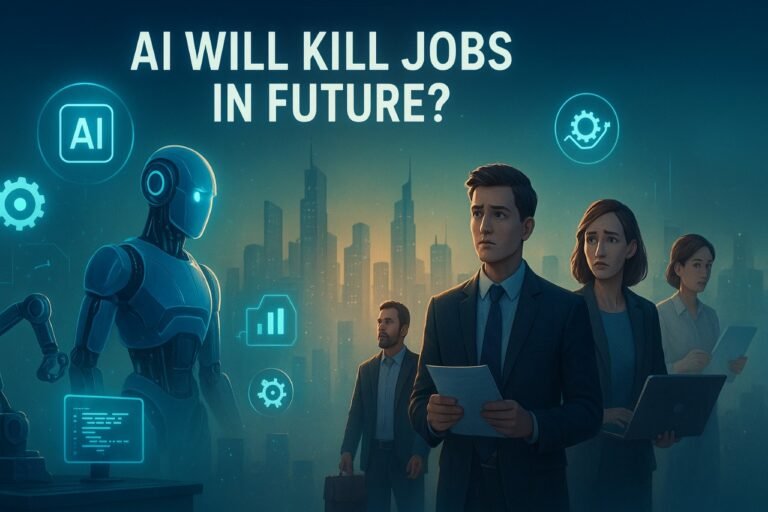
AI may transform many jobs over the next five years—but the people who learn how to use it could be the ones who benefit the most.
Quote:
“AI may change the way we work, but the future belongs to those who learn how to work with AI—not fear it.”
ubaid ullah
AI may change the way we work, but the future belongs to those who learn how to work with AI—not fear it.