Artificial Intelligence (AI) is rapidly changing the healthcare industry. One of its most promising applications is helping doctors detect diseases earlier. From analyzing medical images to identifying patterns in patient data, AI can help healthcare professionals find warning signs that might otherwise be difficult or time-consuming to detect.
Early detection is extremely important in medicine. Many diseases can become more difficult to treat when they are discovered at a later stage. Detecting a potential problem earlier can give doctors more time to investigate, monitor the patient, and consider appropriate treatment.
AI is not replacing doctors. Instead, it is becoming another tool that doctors can use to make healthcare more efficient and data-driven.
What Is AI in Healthcare?
AI refers to computer systems that can analyze information, recognize patterns, and perform tasks that normally require human intelligence.
In healthcare, AI systems can process different types of information, including medical images, laboratory results, electronic health records, and other clinical data.
Machine learning is one of the technologies behind many healthcare AI systems. A machine-learning model can be trained using large amounts of medical data. During training, the system learns patterns associated with particular conditions.
Once properly trained and validated, an AI system can analyze new information and provide predictions or alerts to healthcare professionals.
However, an AI prediction is not automatically a diagnosis. Doctors still need to evaluate the patient’s symptoms, history, test results, and overall medical condition.
AI and Medical Imaging
Medical imaging is one of the most important areas where AI is being used.
Doctors regularly work with X-rays, CT scans, MRI scans, mammograms, ultrasound images, and other medical images. These images can contain thousands or millions of individual details.
AI can analyze these images quickly and identify areas that may require closer examination.
For example, an AI system could analyze a medical image and highlight a suspicious area. A radiologist can then review the highlighted area and decide whether additional investigation is necessary.
This can be particularly useful when hospitals have large numbers of medical images to review.
The U.S. Food and Drug Administration maintains a list of AI-enabled medical devices that includes many technologies used in radiology and other medical specialties. These devices include systems designed to assist with image analysis, detection, diagnosis, and clinical decision support.
AI and Cancer Detection
Cancer detection is one of the most important areas of AI research.
Some cancers can be more effectively treated when detected early. AI is therefore being studied and used to assist healthcare professionals in analyzing medical images and identifying suspicious patterns.
For example, AI technologies can assist with mammogram analysis. They can identify areas that may require additional attention from a radiologist.
AI is also being developed for lung, prostate, and other types of cancer imaging.
The FDA’s database includes AI-enabled technologies designed to assist with cancer-related imaging tasks.
These technologies do not mean that AI can independently detect every cancer. Each medical AI system has a specific purpose and must be evaluated for that purpose.
AI and Heart Disease
AI is also being used to study cardiovascular conditions.
The heart produces electrical signals that can be recorded through an electrocardiogram, commonly called an ECG.
AI models can analyze ECG patterns and identify signals associated with certain cardiovascular conditions.
This can potentially help doctors recognize risks that may not be obvious from a quick examination.
AI can also assist with cardiovascular imaging and other types of heart-related medical data.
The important point is that AI provides additional information. A doctor must still interpret that information alongside the patient’s symptoms and medical history.
AI and Eye Diseases
The eyes provide another interesting opportunity for AI-assisted healthcare.
Special cameras can capture images of the retina, which is located at the back of the eye.
AI can analyze these images and identify patterns associated with certain eye diseases.
One important example is diabetic retinopathy, a condition that can affect people with diabetes.
AI-assisted screening could help healthcare professionals examine large numbers of retinal images and identify patients who may require further evaluation.
This can be especially useful in areas where access to eye specialists is limited.
AI and Stroke Detection
Stroke is a medical emergency where time can be extremely important.
Doctors often use CT or MRI imaging when evaluating patients with suspected stroke.
AI can analyze certain types of medical images and help identify or prioritize potentially urgent cases.
For example, an AI system may flag an imaging study that appears to require immediate attention.
This does not mean the AI makes the final decision. Instead, it can help the medical team identify potentially urgent cases more quickly.
Faster prioritization can be valuable in busy hospitals where doctors may have many scans to review.
AI and Blood Tests
AI is not limited to images.
Blood tests can provide large amounts of information about a patient’s health.
Doctors may need to consider multiple laboratory measurements together rather than looking at only one result.
AI can analyze combinations of laboratory results and identify patterns associated with certain health risks.
For example, an AI model may identify a combination of measurements that is associated with an increased risk of a particular condition.
The result can help doctors decide whether additional evaluation may be appropriate.
Again, an AI prediction should not be treated as a definite diagnosis.
AI and Electronic Health Records
Modern hospitals collect enormous amounts of patient information.
Electronic health records can contain medical histories, laboratory results, previous diagnoses, medications, imaging reports, and clinical notes.
Reviewing all this information can be difficult, especially when doctors have limited time.
AI can help organize and summarize large amounts of medical information.
It can potentially identify important changes in a patient’s history or highlight information that deserves attention.
This can help doctors spend more time focusing on patients instead of searching through large amounts of information.
AI Can Help Find Patterns
One of AI’s biggest strengths is pattern recognition.
Doctors have extensive medical knowledge, but humans have natural limitations when processing huge amounts of information.
AI systems can analyze thousands of images or large datasets much faster than a human could manually compare them.
This does not mean AI is smarter than doctors.
Instead, AI and doctors have different strengths.
AI is good at processing large amounts of structured information and recognizing statistical patterns.
Doctors are good at understanding patients, considering context, asking questions, and making clinical decisions.
Combining these strengths can make AI more useful.
AI Is Not Always Correct
It is important to understand that AI can make mistakes.
An AI system can produce a false positive, meaning it flags something as suspicious when it is not actually a disease.
It can also produce a false negative, meaning it fails to identify something that is actually present.
AI performance can also vary between different patient populations and healthcare environments.
This is why medical AI systems need extensive testing and validation.
Doctors should understand the limitations of the technology and should not blindly follow an AI-generated result.
The Importance of Human Doctors
Even as AI becomes more advanced, doctors remain essential.
A doctor does much more than analyze medical data.
Doctors talk to patients.
They ask questions.
They examine symptoms.
They review medical history.
They consider different possible explanations.
They discuss treatment options.
They explain uncertainty.
AI cannot replace all of these human responsibilities.
The most useful approach is to think of AI as a support system.
It can act like an additional set of analytical eyes while the doctor remains responsible for interpreting the information.
Privacy and Security
Healthcare AI also creates important privacy challenges.
Medical information is highly sensitive.
AI systems may require large datasets to train and operate effectively.
Hospitals and technology providers must protect patient information.
They need appropriate security controls, access management, and privacy practices.
Patients should also understand how their medical information is being used.
Trust is essential for healthcare technology.
The Future of AI in Early Disease Detection
The future of AI-assisted healthcare is promising.
Researchers are developing systems that can analyze multiple types of information at the same time.
Future systems may combine medical images, laboratory results, patient histories, wearable-device information, and other health data.
This could allow doctors to develop a more complete picture of a patient’s health.
Researchers are also exploring whether medical images can contain early signals of diseases that may not yet have obvious symptoms.
For example, NIH highlighted research in 2026 involving an AI model called Merlin that analyzed three-dimensional abdominal CT scans and performed several tasks, including predicting disease onset in research settings.
This type of research demonstrates the potential of AI to move healthcare toward earlier risk identification.
However, promising research still needs careful clinical validation before it should be considered routine medical practice.
Conclusion
Artificial Intelligence is becoming an increasingly important technology in modern healthcare.
It can analyze medical images, process laboratory results, identify patterns, organize patient information, and help doctors prioritize potentially urgent cases.
Its potential to support earlier disease detection is particularly exciting.
Earlier detection can sometimes give doctors more opportunities to investigate a condition and provide appropriate care.
However, AI should not be viewed as a replacement for doctors.
AI can make mistakes, and its performance depends on the quality of its data, training, testing, and implementation.
The future of healthcare is therefore unlikely to be simply “AI instead of doctors.”
A more realistic future is AI working alongside doctors.
AI can process enormous amounts of information.
Doctors can provide clinical expertise, human judgment, communication, and compassion.
Together, these technologies and professionals can help build a healthcare system that is faster, more informed, and potentially better at identifying health problems before they become more serious.
The most important goal is not to make healthcare more technological.
The goal is to use technology responsibly to help healthcare professionals provide better care for patients.
“AI may not replace the doctor, but it can help the doctor see what might otherwise remain unseen.”
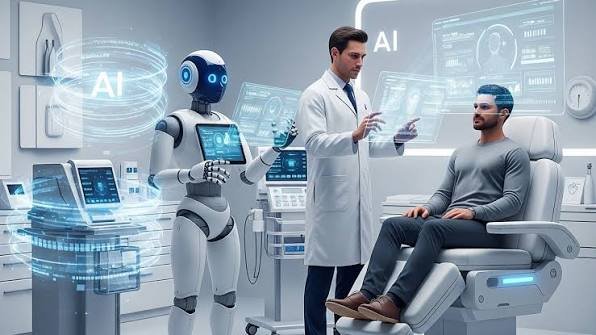
The future of healthcare is not AI versus doctors; it is AI and doctors working together to detect disease earlier.